No KYC
A no-KYC domain registrar paid in Bitcoin, USDT or Monero: no ID, no card
KYC — know your customer — means proving who you are: a passport scan, a selfie, an ID number. Registering a domain does not require it. Here is exactly what we ask, what we never ask, and where identity checks usually slip back in.
Short answer
Tacitroot is a domain reseller, paid only in crypto, that works as a no-KYC domain registrar for you: an ICANN-accredited partner registers the domains, and we sell and manage them without any identity document, selfie, ID number, name, address, phone or card. You give one email per domain — ICANN requires it to be verified — and you pay in Bitcoin (BTC), Tether (USDT), USD Coin (USDC), Ethereum (ETH), Solana (SOL), Litecoin (LTC), Monero (XMR). Extensions whose registry demands a real identity are not sold, or sold only registered in our company's name.
01What we ask, and what we never ask
We ask for one thing: an email address per domain, verified once.
We never ask for:
- a passport, ID card or driving licence;
- a selfie or video check;
- your name, postal address or phone number;
- a card, PayPal or bank account;
- your wallet address or transaction ID.
The full list of what we hold is in our privacy policy.
02Where KYC usually hides
Many registrars do not ask for ID themselves, yet the identity check happens anyway:
- The payment. A card or PayPal account is already tied to your name; the processor did the KYC for the registrar. Some crypto gateways also ask for an identity profile before you can pay.
- The registry. Some extensions require a local presence or a verified identity, whatever the registrar.
- A later review. Some services accept the order, then ask for documents when an order is flagged.
A true no-KYC registration therefore needs three things together: no document at sign-up, a payment that does not name you, and an extension whose registry does not demand identity.
03Extensions that require a real identity
These registries set identity or presence rules, so a no-KYC service cannot sell them honestly:
| Extension | Registry rule | At Tacitroot |
|---|---|---|
| .us | Registrant must have a US connection (nexus); privacy services prohibited | Not sold |
| .ca | Canadian presence requirements | Not sold |
| .eu | Registrant must be in the EU or EEA | Not sold |
| .com.au | Australian presence requirements | Not sold |
| .de, .uk, .nl and a few others | Registrar privacy services do not apply | Sold only in our company's name (Domain protection) |
04How other registrars compare
From each provider's own pages, read 12–18 November 2026: Njalla asks only an email or XMPP account and owns the domain for you; IncogNET asks an email but reviews orders by hand; Gandi takes crypto through a payment gateway that requires an identity profile; Cloudflare takes only card or PayPal; for Namecheap and Porkbun we found no official statement either way. The full table, with sources, is on best anonymous domain registrars; a focused comparison with Njalla is on Njalla alternative.
05Register without KYC in three steps, paid in crypto
Search the name
Use the search above. Availability comes live from the registry.
Add one email and pay
Top up your balance with crypto — minimum $25 — and confirm the order. Nothing else is asked.
Manage it
The domain is registered for you with privacy on. DNS, renewals and the transfer code are in your account.
06What the payment step actually asks for
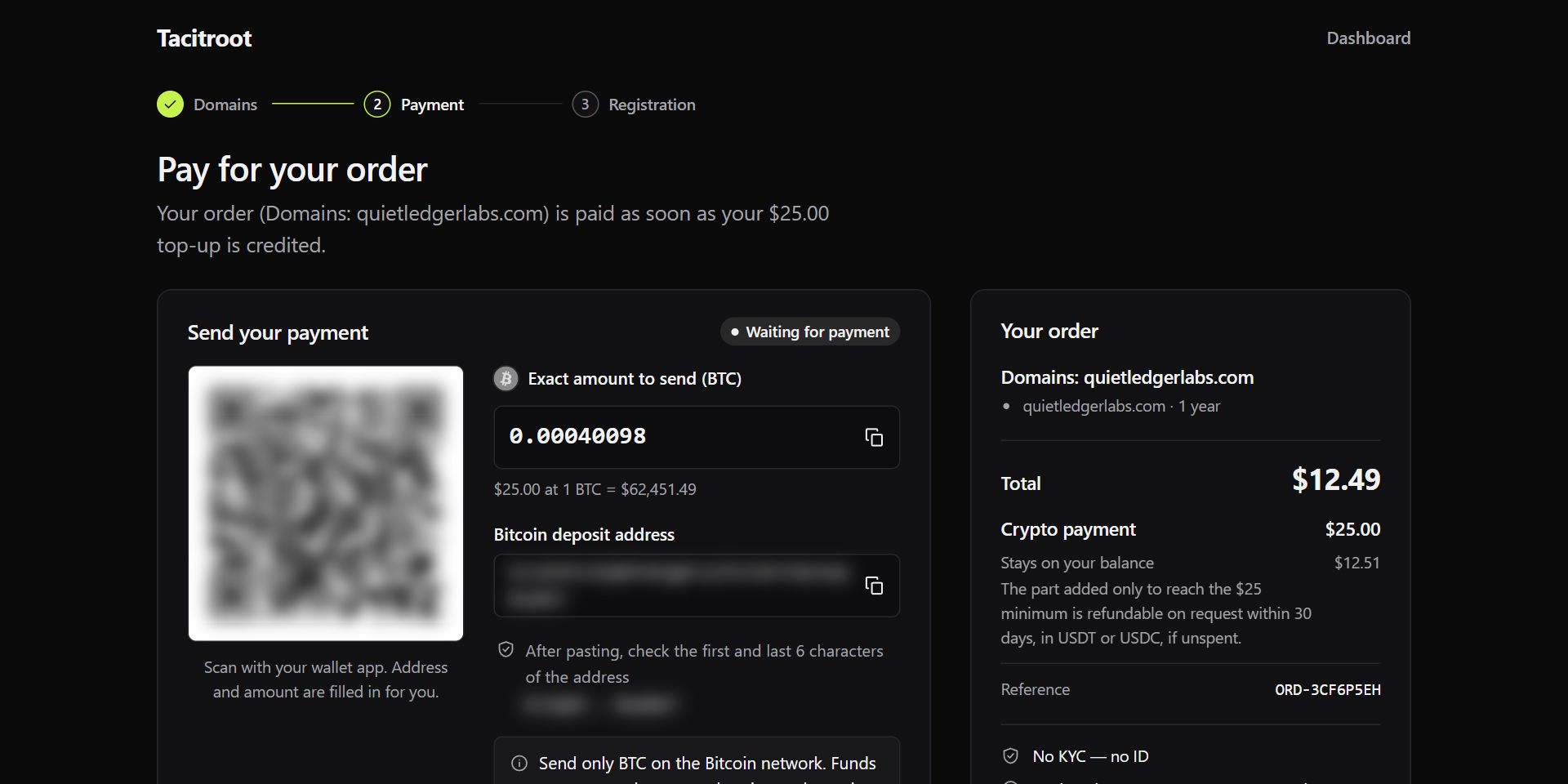
No name, no address, no card form. After one email for the domain, the checkout shows a single exact amount in the coin you picked, at the live rate, and a deposit address.
07No ID, no KYC: what people ask
Is a no-KYC domain registration legal?
Yes. No law requires a registrar to check identity documents for an ordinary domain. ICANN requires a contact that works and is verified, which is why we verify one email.
Why do you need an email at all?
ICANN's contract requires registrars to be able to reach the domain's holder and to verify that contact. We use it for verification, renewal reminders and legal notices; it is never published.
Will you ask for ID later?
No, for any order. If a registry starts requiring identity for an extension, we stop selling it or sell it only in our company's name.
Is no-KYC the same as anonymous?
Close, but not the same. No-KYC is about identity checks; anonymity also depends on your payment, your email and your hosting. See our anonymous registration guide.
Does paying Namecheap in Bitcoin make it a no-KYC registrar?
No. Bitcoin only tops up your Namecheap balance; the account and the domain contacts stay the same. See Namecheap crypto payment.
Sources
- usTLD — privacy services policy (29 August 2019) — read 18 November 2026
- ICANN — Registration Data Policy — read 18 November 2026
- ICANN — 2013 Registrar Accreditation Agreement, Whois Accuracy Program Specification — read 18 November 2026
- Njalla — FAQ — read 18 November 2026
Register a domain without ID
One email, paid in crypto, privacy included.